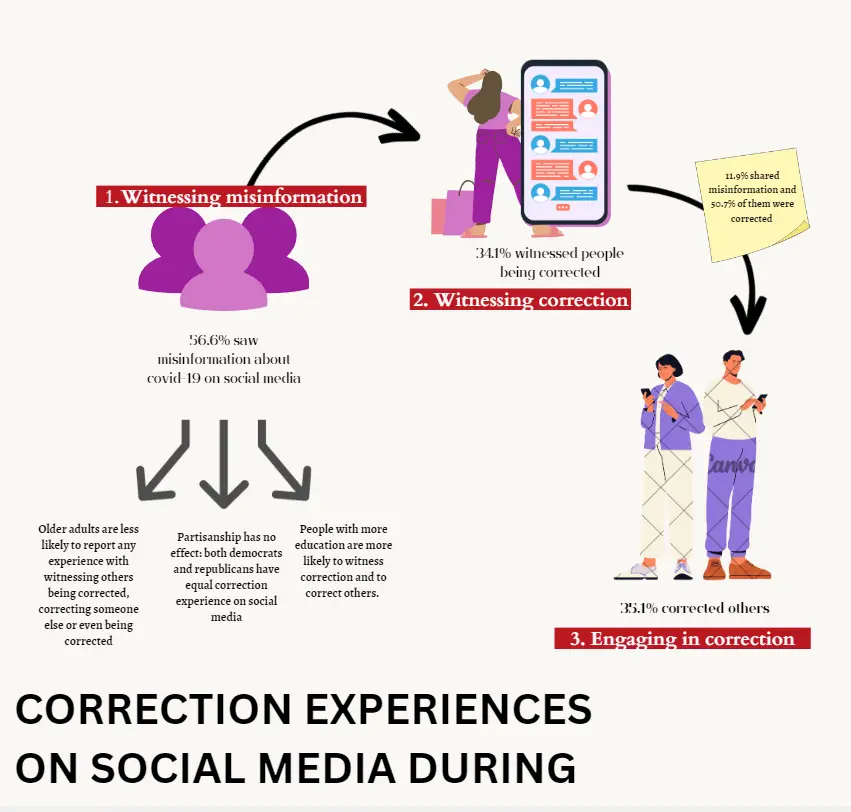
In this article, we aim to document how often people experience correction of misinformation on social media in the context of COVID-19 in three ways: witnessing someone else being corrected, engaging in correction of others and being corrected themselves. We also aim to understand whether people from certain demographics like age or partisan are more or less likely to experience correction in the three ways. We specifically focus on correction which occurs after exposure to misinformation including seeing a fact-check, from a platform or another user.
Just over half of participants reported seeing misinformation about covid-19 on social media in the past week while a third reported witnessing someone else being corrected and a quarter reported correcting someone else who shared misinformation on social media. Likewise, of the 12% who said they shared misinformation, over half said they were corrected.
Demographically, we found that older adults are less likely to report all experiences with correction and those with more education were more likely to report witnessing correction and correcting misinformation themselves while partisan identification is unrelated to correction experiences. We think the relationship between education and witnessing correction is likely a homophilous network– those with greater education are more likely to have similar education connections who are more likely to engage in correction. Coming to Information sources, those who rely on health experts were more likely to report correcting others as opposed to those relying on news media who were less likely to correct and witness corrections.
With research suggesting that seeing and experiencing correction can reduce misperception, this looks quite promising as we also believe that experiencing corrections creates a virtuous circle and can help make correction a community response to misinformation on social media.