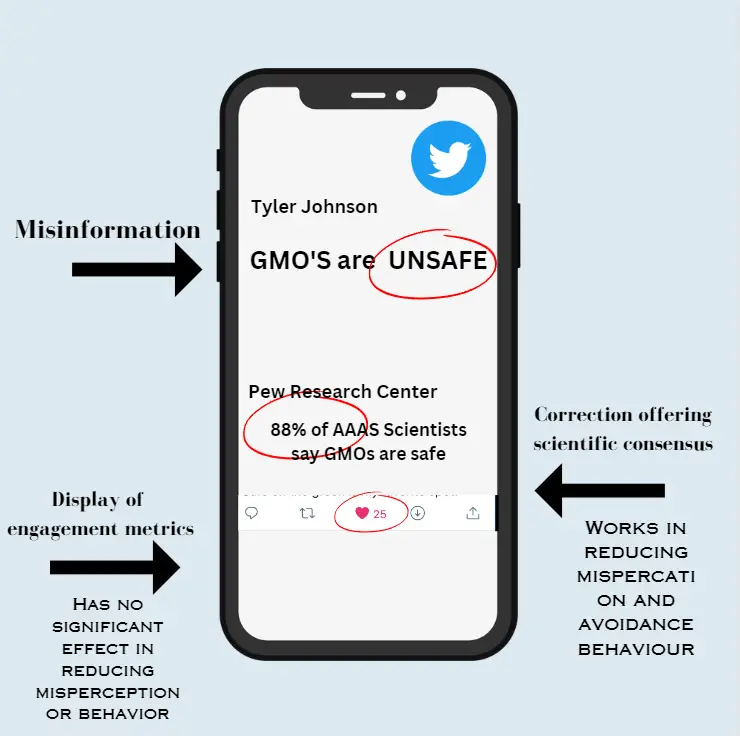
Current research suggests that expert organizations can be effective in reducing misperceptions when they respond to health and scientific misinformation on social media. We examine this through the case for safety of genetically modified food. We focus on whether, as claimed by the Gateway Belief Model, communicating that experts have a consensus works as a way to reduce misperceptions and whether displaying social media engagement metrics– “likes” on twitter– can amplify this effect. To test this, respondents randomly saw one of six simulated twitter feeds– misinformations feeds claimed the GMOs are unsafe and had no responses, in correction feeds PEW Research Center says that 88% of the scientific community claims otherwise but has no likes and in the other condition this response has 35 “likes” .
Firstly, offering corrections overall was successful at reducing misperceptions and avoidance behavior related to GMF– providing support for the Gateway Belief Model. Interestingly, the “likes” did not play any significant role in making people more likely to accept corrective information or perceiving the corrective organization as more credible.