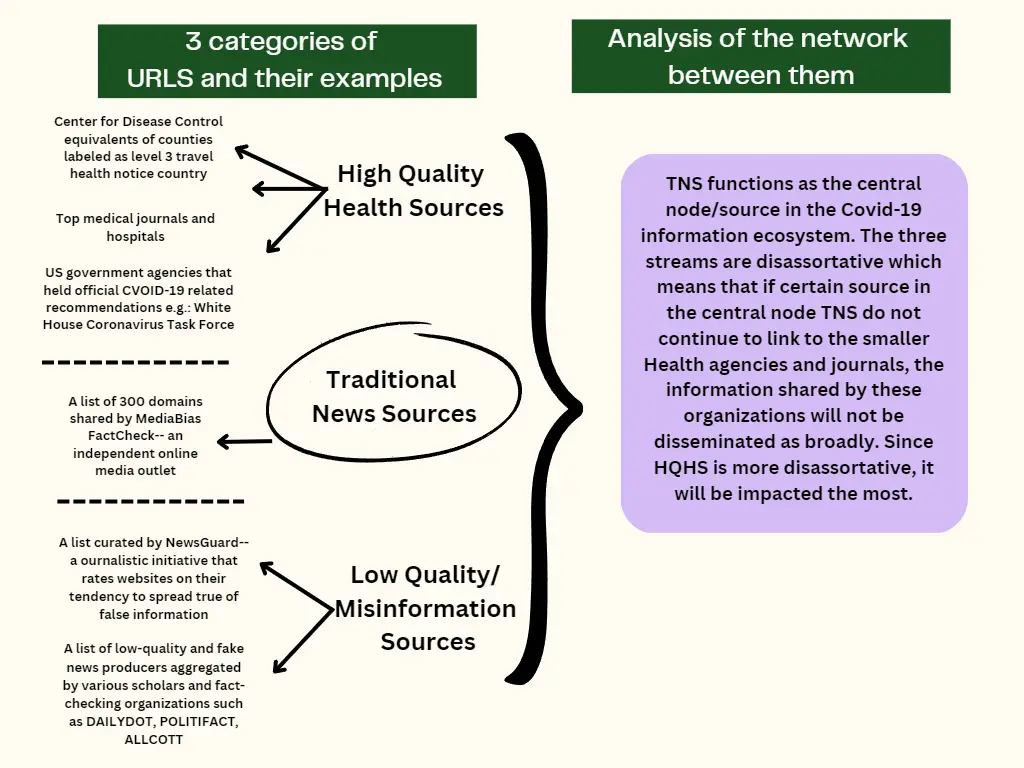
This article investigates the information sources (URLS or webpages) being shared on Twitter when users discuss Covid-19 distinguishing between high quality health sources, traditional news sources and low quality information sources. The motivation is find out the types and frequency of URL content to understand the original producers of content that users are sharing and to contribute to the Covid-19 information ecosystem to understand the dynamics of the networks of the subgroups in the ecosystem: Do different categories of sources link to each other and which categories link to one another most often?
High Quality Health Sources include reputable web domains like different country’s (identified by CDC as a Level 3 travel health notice country) equivalent to a Center for Disease Control and top medical journals and hospitals. Traditional News Sources include a list of 300 web domains shared by MediaBias FactCheck– an independent online media outlet. Finally, Low-Quality/ Misinformation sources include a list curated by NewsGuard– a journalistic organization that rates websites on their tendency to spread true or false information. To identify their network dynamics, domain source and destination pairs were identified. Of the dataset of tweets and retweets, News sources accounted for the highest tweets and retweets with 7.6% and 1.2% respectively.
While analyzing the network dynamics we studied the sources which are being linked to within the web pages themselves– within TNS (being the dominant news source) over 1112,447 have HQHS, over 110,390 have LQMS. In other words, 478 TNS were mentioned in at least 100 tweets and contain at least one article that links to either HQHS or LQMS. News sources hence play a central brokerage role in the information ecosystem as the high quality and low quality sources are not connected to each other. This suggests a disassortative connection which means that if certain central nodes i.e. sources do not continue to link to the smaller health agencies and journals the information shared by those organizations will not be disseminated as broadly since redundant pathways do not exist.